
Disclaimer
The views, opinions, and content expressed on this website are solely those of Rosabel Zohfeld, based on her personal and professional experience, and do not reflect the views of, nor are they affiliated with, any hospital, healthcare facility, medical practice, or organization.
All information shared here is for educational and informational purposes only and should not be taken as medical advice. Nothing on this website creates a doctor-patient relationship between Rosabel Zohfeld and any visitor. Visitors should always consult with a qualified healthcare professional regarding any medical concerns or decisions.
By accessing this website, you acknowledge and agree that Rosabel Zohfeld is acting in her individual capacity and not as a representative of any institution or employer.
There is a treatment for Alzheimer’s disease that can slow progression in a specific window of time. Most families learn about it either too early to fully grasp its limits or too late to use it.
If someone mentioned Leqembi and you spent hours reading studies and forum posts only to feel more confused, that is not a failure of understanding. It is a failure of clear explanation, and it happens to nearly every family that encounters this topic.
Leqembi Alzheimer’s treatment (lecanemab) is not a cure. It is not a reversal. It is a modest slowing of a biological process in the right person, at the right stage, with careful monitoring.
Understanding that distinction allows families to make grounded decisions instead of being swept up by hope or fear.
This guide walks through what Leqembi actually does inside the brain, the real 2026 data (not the headlines), who qualifies, the risks, and what it cannot do.
It also covers the part almost every explanation skips: why the timing of the decision matters more than almost anything else.
What Leqembi Alzheimer’s Treatment Actually Does in the Brain
In early Alzheimer’s, a protein called beta-amyloid begins to misbehave. Normally the brain produces and clears amyloid as part of routine maintenance. In Alzheimer’s, that clearance becomes less efficient, and amyloid accumulates.
The most damaging forms are not the large plaques often discussed in media. They are the smaller soluble forms called protofibrils. These appear earlier and are especially toxic to synapses—the connection points where one brain cell communicates with another.
When protofibrils cluster around synapses, they disrupt communication, trigger inflammation, and stress neurons. Over months and years, this produces the changes families notice: word-finding difficulty, repeated questions, and gradual withdrawal from complex tasks.
The brain’s own immune cells (microglia) are supposed to clear the amyloid, but in Alzheimer’s, they cannot keep up.
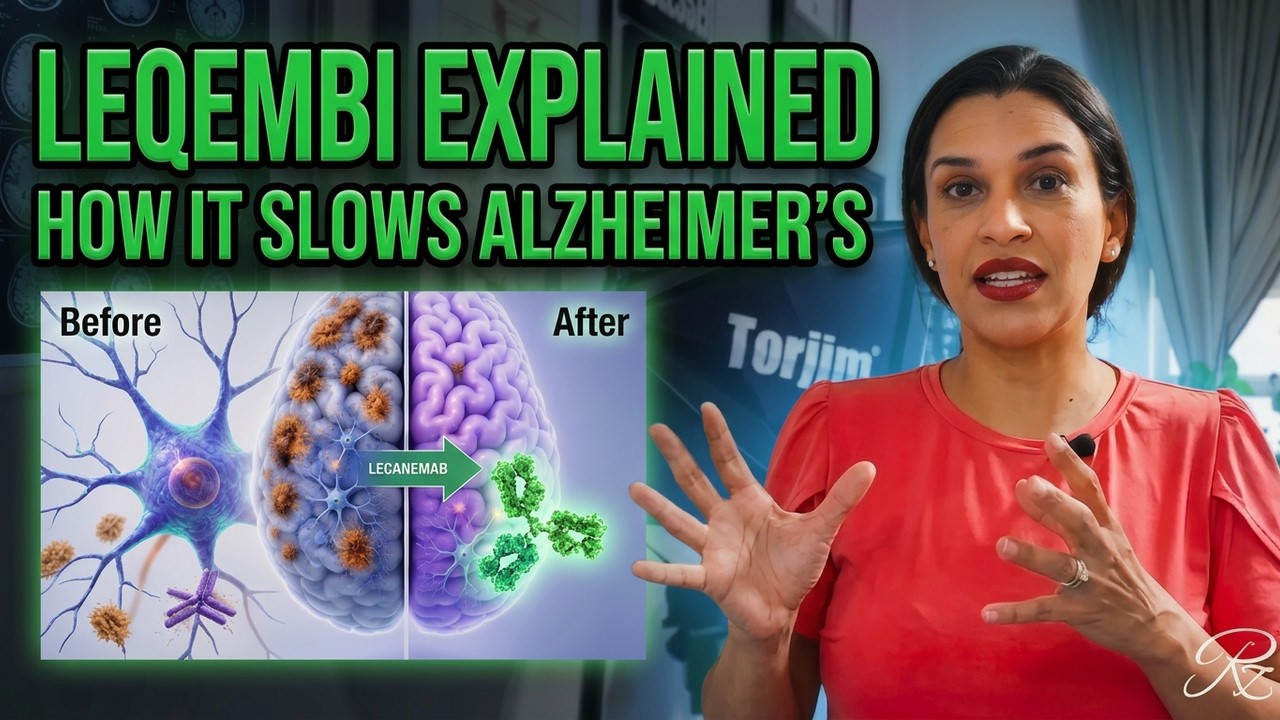
Leqembi is a monoclonal antibody—a precisely engineered protein designed to bind specifically to those soluble protofibrils.
Once it binds, it flags them for clearance by activating the immune system through the Fc fragment. Microglia then clean up what they could not handle alone. Clinical trials showed measurable reduction in amyloid burden on PET scans and a corresponding slowing of cognitive decline.
The Real Data on How Much Leqembi Alzheimer’s Treatment Slows Decline
The pivotal Clarity AD Phase III trial enrolled 1,795 participants with early Alzheimer’s and confirmed amyloid pathology.
Over 18 months, lecanemab produced approximately 27% less decline on the CDR-SB scale (a global measure of cognition and daily function) compared with placebo. The absolute difference was 0.45 points.
That 27% sounds modest, and it is. Practically, it means several additional months of preserved independence—managing medications, recognizing faces, remaining present at dinner.
For many families, that time is everything.
Longer-term open-label extension data through four years shows the benefit continuing and widening.
Compared with natural-history cohorts such as ADNI, the difference on CDR-SB reached roughly 1.75 points at 48 months. In people who started with lower amyloid or lower tau burden, some analyses suggest the potential to delay progression by several years.
These results confirm a disease-modifying effect, but they also reinforce that benefit depends heavily on starting early.
Who Qualifies for Leqembi Alzheimer’s Treatment and What the Risks Really Are
Not everyone qualifies. Eligibility requires confirmed amyloid pathology (PET scan or cerebrospinal fluid testing) and early-stage disease—mild cognitive impairment or mild dementia.
People with moderate or severe Alzheimer’s are not candidates. Contraindications include recent stroke, significant microhemorrhages, or certain vascular conditions.
APOE4 status matters significantly. This gene variant raises both Alzheimer’s risk and the risk of the most important side effect: ARIA (amyloid-related imaging abnormalities).
ARIA means temporary brain swelling or small areas of bleeding visible on MRI. Overall ARIA incidence in trials ran around 12–21%. Symptomatic ARIA occurred in roughly 3%.
Most cases resolve, but rare serious events have occurred, which is why close MRI monitoring, especially in the first several months, is non-negotiable.
Cost remains real—tens of thousands of dollars per year. Medicare Part B covers Leqembi for eligible patients who meet criteria and are treated by providers participating in a qualifying registry.
Patients typically face 20% coinsurance after the Part B deductible unless they have supplemental coverage. Access often requires a specialized center.
What Leqembi Alzheimer’s Treatment Cannot Do—and Why Timing Matters Most
Leqembi does not stop Alzheimer’s disease. It does not reverse damage already done. It slows a biological process inside a specific window: early stage, confirmed amyloid, appropriate risk profile.
That window does not stay open forever. Starting later means less potential benefit because more irreversible damage has already occurred.
This is why the conversation belongs with the neurology team, with the specific stage, genetic profile, vascular history, and personal goals on the table.
The most useful preparation is a clear understanding of both what the medication can offer and what it cannot.
Three Practical Steps Families Can Take Right Now
- If a loved one has a recent diagnosis of mild cognitive impairment or early Alzheimer’s and Leqembi has not been discussed, ask specifically at the next appointment: “Is my loved one a candidate for lecanemab infusions, and what would the evaluation process look like?”
- If already in the evaluation process, obtain APOE4 genotyping early. The result shapes the entire risk-benefit discussion. It is not an automatic reason to say no, but it is information families need clearly in hand.
- Whether or not this medication becomes part of the path, foundational lifestyle work remains the most powerful long-term lever: deep sleep, consistent aerobic and resistance exercise, vascular risk management (blood pressure, blood sugar, cholesterol), and stress reduction. These are biological infrastructure that determine how resilient the brain is. Leqembi works best in a brain that is otherwise being protected—alongside lifestyle, not instead of it.
Hope and Realism Can Exist Together
To every family member who has spent midnight hours researching studies and printing questions: you are doing exactly what a good advocate does.
You are trying to understand and get it right.
Hope and realism are not opposites. Bringing both into the neurologist’s office—clear knowledge of what Leqembi Alzheimer’s treatment can and cannot do—gives real agency.
For a complete, plain-language landscape of Alzheimer’s care, including medication, staging, and what to expect, explore the free Understanding Dementia guide created for caregivers: https://rosabelzohfeld.com/understanding-dementia/. Additional free resources live at https://rosabelzohfeld.com/rosabelievers/.
Connect with Rosabel Zohfeld
Rosabel Zohfeld is a neurology nurse practitioner and neuroscience educator who hosts the Rosabel Unscripted podcast and specializes in helping families navigate dementia with clarity and compassion.
- Website: https://rosabelzohfeld.com/
- Free Understanding Dementia course: https://rosabelzohfeld.com/understanding-dementia/
- Book The Courage to Succeed: A True American Dream: available on Amazon
- Instagram: @rosabelunscripted
- TikTok: @rosabelzoh
- X: @withRosabel
- YouTube: Rosabel Unscripted
If this clarified the picture where there was confusion before, share it with another family navigating the same moment.
You are not alone. One clear piece of understanding at a time.
Disclaimer The information in this article is for general educational and informational purposes only. It is based on publicly available science, clinical experience, and content originally shared on the Rosabel Unscripted channel. This content does not constitute medical advice, nursing advice, diagnosis, or treatment, and does not create a nurse-patient or provider-patient relationship.
Always consult your own physician or qualified healthcare provider regarding any medical condition or decisions about your health or the health of a loved one. Never disregard professional medical advice or delay seeking it because of something you have read here.
If you are experiencing a medical emergency, contact your healthcare provider or call emergency services immediately. Views expressed are my own and are based on current scientific understanding and clinical experience. Individual results and needs vary.


Free for new subscribers
Get Module 1 of my dementia course free
Plus my weekly email: one clear, science-based idea for your brain and the people you care for. Unsubscribe anytime.